Minimum Ignition Energy Apparatus ‚MIKE‘
1992 - 2016 manufactured by Adolf Kühner AG, Birsfelden, Switzerland
Apparatus for determining the minimum ignition energy of dust/air mixtures.
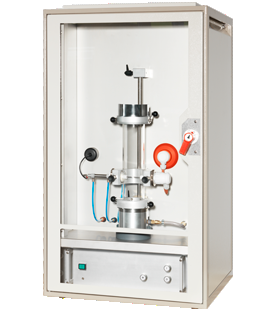 Minimum ignition energy (MIE) is the lowest energy value that a high-voltage capacitor discharge must apply, to ignite the most ignitable dust/air mixture.
These indices are determined in accordance with international standards in the MIKE laboratory apparatus:
Minimum ignition energy (MIE) is the lowest energy value that a high-voltage capacitor discharge must apply, to ignite the most ignitable dust/air mixture.
These indices are determined in accordance with international standards in the MIKE laboratory apparatus:
- • EN 13821: Determination of minimum ignition energy of dust/air mixtures
- • EN ISO/IEC 80079-20-2: Explosive atmospheres. Material characteristics. Combustible dusts test methods
- • ASTM E2019: Standard Test Method for Minimum Ignition Energy of a Dust Cloud in Air
| Test condition \ Apparatus | MIKE3 | MIKE4 |
|---|---|---|
| • Atmospheric |  |
|
| • Increased temperature | → | |
| • Reduced oxygen | → | |
Operation
A modified Hartmann tube made of glass with a volume of 1.2 liter is used as the explosion vessel. The dust dispersion system at the base of the tube is of the "mushroom-shaped" type around which the sample is loosely scattered. A blast of compressed air at 7 bar is used to disperse the dust in the glass cylinder where it is ignited by a spark between two electrodes.
Measurement Range
Experiments have shown that dust/air mixtures can easily have MIE values less than 10 mJ. The measurement range of the MIKE 3 has thus been extended to lower energy values. The high-voltage component has been specially designed for the low ignition energies.
Thanks to pneumatically actuated high-voltage switches, the parasitic capacitances have been reduced by an order of magnitude.
Energy range: 1mJ ... 1000mJ
NEW Software MIKE 4.0
for MIKE3-CAN and MIKE4-CAN
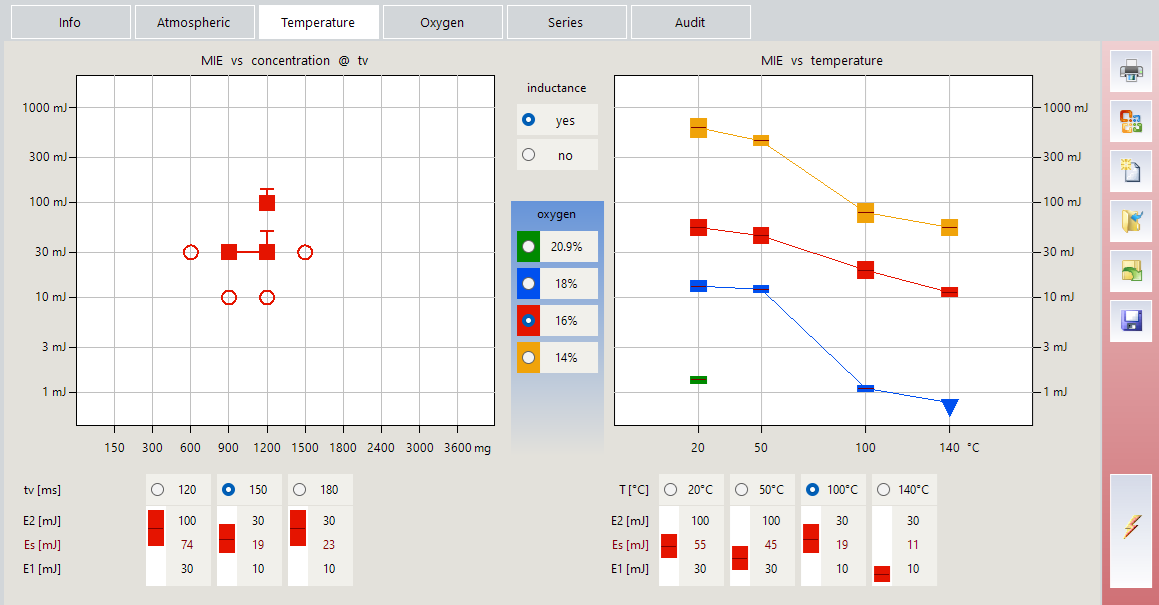
Example 1: MZE vs temperature (parameter = oxygen content)
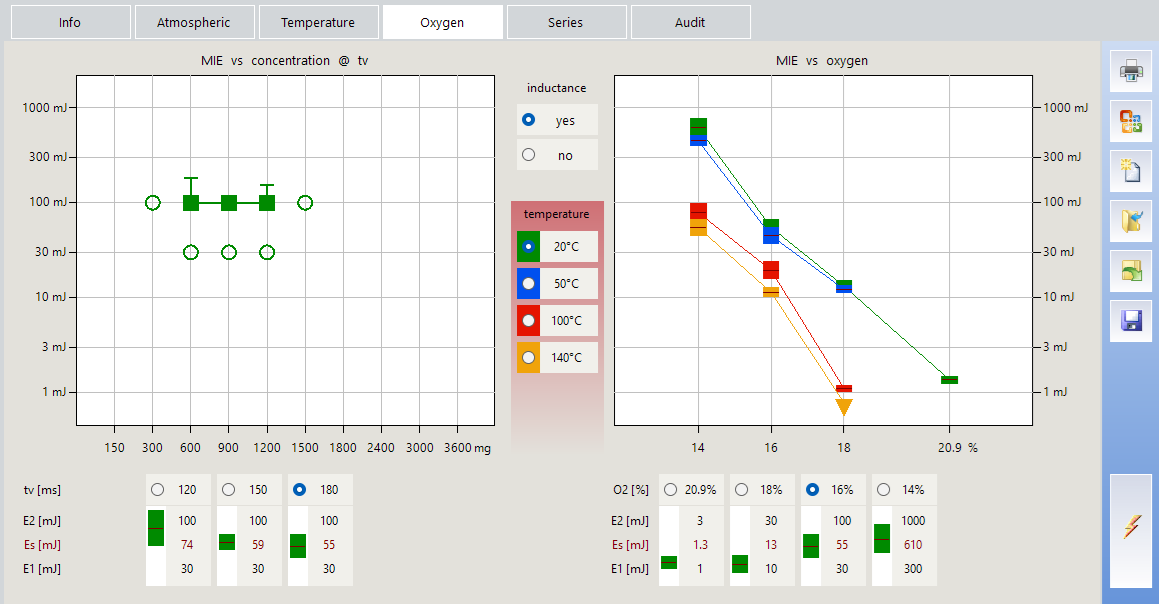
Example 2: MZE vs oxygen content (parameter = temperature)
Download, Updates

Software for Microsoft-Windows 7…11
 MIKE 3.5 Setup for MIKE3 (1992 - 2019)
- MIKE 4.0 Setup for MIKE3/4-CAN (starting 2020)
In the office, we recommend the new MIKE 4.0 software, as this can read all older files.


